
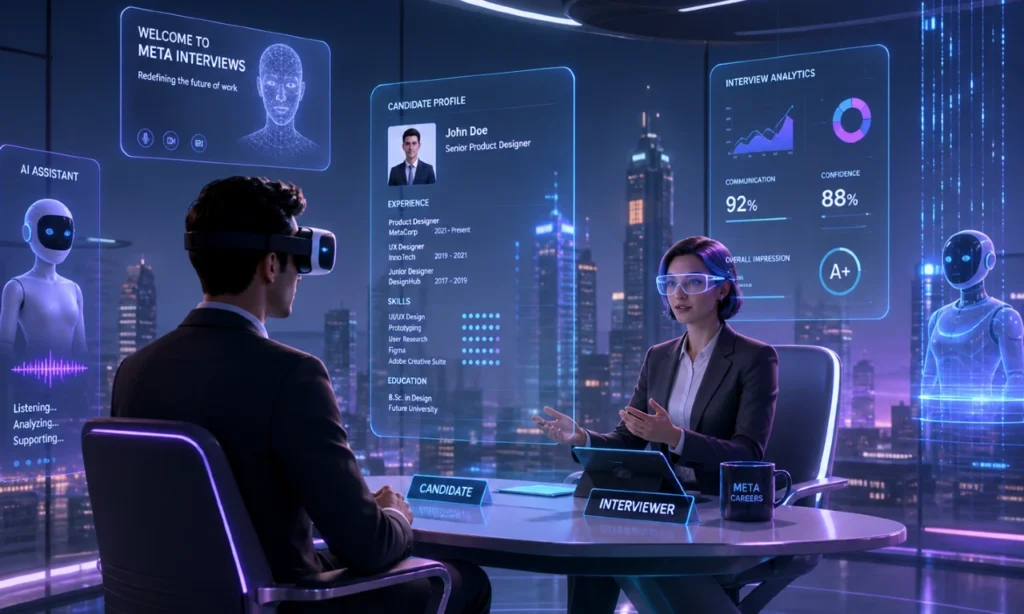
Imagine this: You straighten your shirt, take a deep breath, and instead of driving across town to an unfamiliar office building, you put on a lightweight pair of smart glasses. You are instantly transported into a sleek, modern boardroom. Across the table sits your potential manager—not as a pixelated face on a flat screen, but as a life-sized 3D avatar sitting right across from you. Will Your Next Job Interview Happen in the Metaverse? It may sound like science fiction, but for a growing number of global companies, this scenario is already becoming a reality. As we progress through 2026, the way we connect, collaborate, and get hired is fundamentally shifting into three dimensions.
What Is a Metaverse Job Interview?
A metaverse interview is not simply a Zoom call with a funny background. It is an immersive, interactive experience where you enter a shared digital space. Unlike standard video conferencing, these virtual environments use spatial audio and expressive avatars to mimic the nuances of a real conversation. When you physically turn your head, your avatar does too. When you speak, the sound comes from your direction, making the interaction feel much closer to a genuine in-person meeting than a traditional call.
This evolution addresses a major pain point of remote hiring: the lack of human connection. On video calls, we often stare at a grid of muted boxes, missing the subtle body language cues essential for building trust. In the metaverse, you can walk up to a virtual whiteboard to sketch an idea or have a side conversation with a future teammate naturally.
Why Companies Are Moving to VR Hiring
The push toward virtual hiring isn’t just a gimmick. Businesses are discovering that immersive recruitment solves genuine logistical and human resources challenges.
Breaking Down Geographical Barriers
One of the strongest drivers is access to global talent. A company in New York can host a career fair in a virtual lobby where candidates from Tokyo, London, or Lagos can join simultaneously. Nobody has to book a flight or worry about travel expenses. This makes the candidate pool much broader and levels the playing field for international applicants.
Deeper Assessment of Skills
Traditional screening methods frequently rely on resumes and gut feelings formed in the first few minutes of small talk. In a VR setting, an interviewer can observe your actual behavior. For a project management role, they might ask you to rearrange a chaotic virtual warehouse. For a creative role, you might step into a 3D design studio to brainstorm. This gives employers a live demonstration of your soft skills and problem-solving abilities without the pressure of a formal test environment.
Enhancing Employer Branding
Companies using this technology signal that they are forward-thinking and innovative. This is a massive advantage when competing for top tech talent. Showing a candidate a virtual fly-through of your “future office” leaves a much stronger impression than sharing a corporate PDF brochure. It also gives the candidate a better sense of whether they actually enjoy the company culture.
How the Right Gear Makes the Difference
The experience of a metaverse interview can vary wildly depending on the technology you use. Not all screens and lenses are created equal. When you are trying to judge a subtle facial expression or get a feel for someone’s energy, visual clarity and comfort aren’t luxuries; they are necessities.
Seeing the True Picture with Advanced Optics
We often talk about “seeing eye-to-eye” with someone to build rapport. In the digital realm, this requires display technology so crisp that it tricks the brain into thinking the virtual person is real. This is where specialized devices step in. For example, smart glasses designed for this new era incorporate high-resolution optics that ensure the hiring manager’s avatar isn’t a blurry 8-bit puppet, but a distinct, clear presence. Whether it’s the lifestyle-focused Ray-Ban Meta glasses that act as your casual gateway to digital connection, or the ruggedized lenses built for extreme environments like Oakley Meta, the clarity of the display directly impacts the authenticity of the connection.
Reducing Fatigue with Ergonomic Design
Interviews usually last around 45 to 60 minutes. That’s precisely the timeframe where uncomfortable hardware starts causing “VR fatigue”—that eye strain or headache that makes you want to tear the headset off. Cutting-edge VR headsets, like the Meta Quest 3, solve this with pancake lenses and balanced weight distribution, making it easy to forget you’re even wearing a screen. True immersion doesn’t mean strapping a brick to your face; it’s about lightweight, breathable designs that allow your natural personality to shine through without physical distraction . You aren’t looking at a screen; you are entering a room through a pair of display glasses so advanced they become invisible.
The Real Benefits for Candidates
It’s not just employers who benefit. If you are a job seeker, this shift could be very good news.
- You Control Your Comfort Zone: On a bad mental health day, forcing a blank “professional mask” on video can be draining. In the metaverse, an avatar can display professional body language even if you are in a comfortable, safe space. It helps separate your physical insecurities from your professional capabilities .
- Equal Footing: In a physical office, a candidate in a wheelchair or someone with a visible difference might face unconscious bias before they even speak. In a virtual room, an avatar allows the focus to remain entirely on your voice, ideas, and personality during those critical first impressions .
- Memorable Interactions: Flat video calls tend to blur into monotony for recruiters doing back-to-back screenings. A candidate who confidently navigates a 3D space or interacts with a virtual prototype leaves a lasting, positive impression. PwC research has noted that VR learners are more emotionally engaged and retain information better, a principle that translates directly to being remembered in an interview setting.
Challenges Still on the Horizon
Of course, we aren’t yet at the point where every interview starts with putting on a headset. Several hurdles remain before this goes fully mainstream.
The Digital Divide
Not everyone owns a VR headset yet, though numbers are rapidly climbing. Market forecasts predict that VR and MR headset market size will grow significantly, from around 22billionin2026toover100 billion by 2032. As prices drop and technology finds its way into more homes, this barrier will continue to lower. Still, companies must offer 2D web-based alternatives for a fully inclusive process right now.
The Learning Curve
While Gen Z and younger millennials are often native to virtual gaming worlds, some candidates find the technology intimidating. Glitches, “how do I unmute?” moments in VR, or battery anxiety can add new stress to an already tense situation. However, as 171 million people globally now use VR regularly, comfort levels are rising fast.
Authenticity Concerns
A critical question is whether the technology masks true personality or reveals it. While avatars reduce physical appearance bias, the lack of full facial tracking (outside of high-end professional gear) can sometimes hide the micro-expressions that make us human. The sweet spot lies in mixed reality, where virtual elements blend with the real world, keeping the interaction grounded while still fantastical.
How to Prepare for a Virtual Reality Interview
If you get an invitation for an immersive interview soon, don’t panic. Treat it like the next logical step up from a video call.
- Scope the Space: Ensure you have a clear, safe physical play area. You don’t want to swing your hand into a coffee mug while gesturing to a 3D chart.
- Test Your Tech Early: Log into the platform (like a Workrooms-type app) 15 minutes early. Check your mic and make sure your avatar looks professional .
- Be Spatially Aware: Use the spatial audio feature. Don’t talk over people if you see their avatar’s mouth moving. You can even physically “walk” over to a specific person in a group setting to have a private conversation.
- Dress the Part (Sort Of): You just need a sharp-looking digital avatar, but wearing a collared shirt behind the headset might still trick your brain into “professional mode.”
Final Thoughts: A 3D Future for Talent
The transition is inevitable. Just as email replaced the printed memo and video calls replaced the phone screening, virtual presence is the next step. It rebuilds the bridge between remote convenience and physical connection. While traditional face-to-face meetings for final-round executive hires likely won’t vanish entirely, the early rounds of screening, testing, and global talent scouting will increasingly take place in the metaverse.
The future of job seeking isn’t just about sending a link to a camera; it’s about stepping through a portal into a new professional dimension. So, keep your resume polished, but also maybe think about how you want your avatar to look. Will Your Next Job Interview Happen in the Metaverse? The answer isn’t a matter of “if,” but “how soon.”