
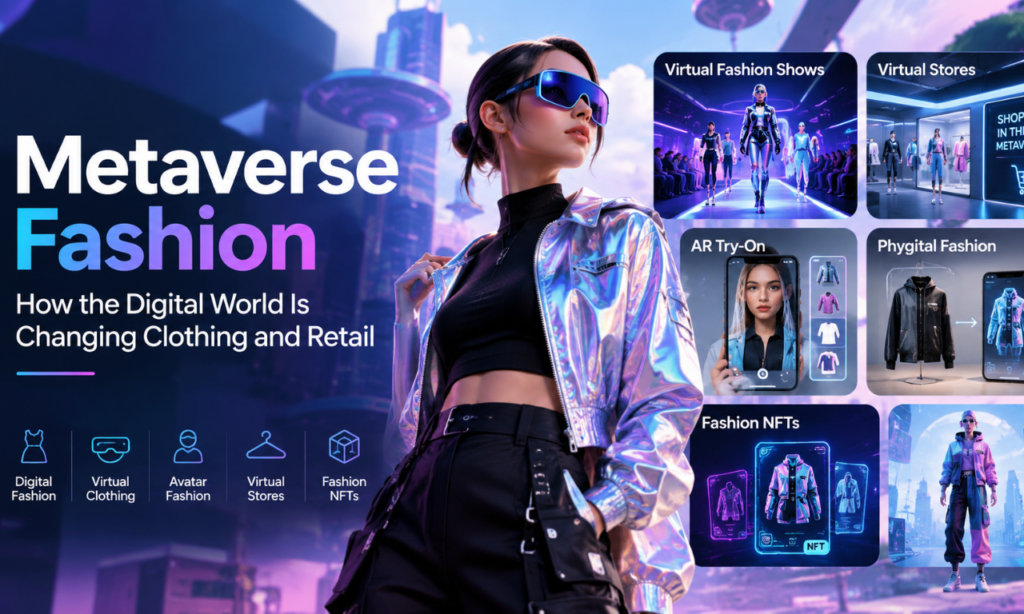
Fashion has always evolved with technology. From online shopping and social media to artificial intelligence and augmented reality, technology continues to change how people discover, wear, buy, and experience clothing.
The next stage of this evolution is taking fashion into digital and immersive environments.
Metaverse fashion combines clothing, digital identity, virtual experiences, gaming, augmented reality, 3D design, and online commerce. Instead of fashion existing only as a physical product, it can also become something people wear, collect, customize, and experience digitally.
Fashion brands have already explored virtual collections, avatar clothing, digital experiences, virtual stores, gaming environments, and NFTs. Research also increasingly examines how consumers interact with digital fashion and how virtual experiences can connect with real-world fashion purchases.
But what exactly does metaverse fashion mean, and how could it change the clothing industry?
What Is Metaverse Fashion?
Metaverse fashion refers to fashion experiences, products, and activities that take place partly or entirely in digital or immersive environments.
This can include:
- Digital clothing
- Virtual outfits
- Avatar fashion
- 3D fashion design
- Virtual fashion shows
- Virtual fashion stores
- AR virtual try-on
- Digital fashion collectibles
- Fashion NFTs
- Physical products connected to digital experiences
The important point is that metaverse fashion is not limited to one technology. It can involve virtual worlds, gaming platforms, augmented reality, virtual reality, artificial intelligence, blockchain, and 3D technologies.
Academic research describes the metaverse-fashion connection as an emerging area where brands can create new forms of marketing, brand experiences, consumer interaction, and digital products.
Why Is Fashion Moving Into the Metaverse?
Fashion is closely connected with identity and self-expression. People use clothing to communicate their personality, interests, social identity, and style.
That same behavior can extend into digital environments.
A person may want to look different in a video game, social virtual world, digital event, or other online environment. This creates an opportunity for clothing to become a digital product as well as a physical one.
Research on Generation Z has found that avatar identification and alternative digital identity can positively influence attitudes toward using digital fashion items in the metaverse.
For fashion companies, this creates several possible opportunities:
- Reaching consumers in digital environments
- Creating new types of products
- Building virtual communities
- Experimenting with new designs
- Creating immersive brand experiences
- Connecting physical and digital shopping
- Offering digital products and collectibles
McKinsey has also identified virtual fashion, NFTs, gaming, and immersive experiences as areas fashion brands have explored as part of their metaverse strategies.
Digital Fashion and the Rise of Virtual Clothing
One of the most obvious connections between fashion and the metaverse is digital fashion.
Digital fashion refers to clothing and fashion products created primarily for digital environments rather than physical use.
A designer can create a 3D jacket, dress, pair of shoes, or accessory that can be displayed on an avatar or used in a digital environment.
This eliminates some of the physical limitations of traditional clothing design.
A digital designer can experiment with unusual shapes, materials, colors, animations, and designs that may be difficult or impossible to produce physically.
Learn more about digital fashion and how digital garments are changing the fashion industry.
What Is Virtual Clothing?
Virtual clothing is a major part of digital fashion. It refers to clothing designed for digital characters, avatars, social platforms, games, or virtual environments.
Instead of putting a physical shirt on your body, you can put a digital version on your avatar.
This creates a completely different type of fashion market.
A digital outfit does not need fabric, a physical factory, shipping, or a traditional retail shelf. Instead, it can be created as a digital asset and delivered electronically.
Virtual clothing can also be designed for specific digital environments. Some outfits may be created for games, while others may be designed for social avatars or virtual events.
Read more about virtual clothing and how digital outfits are redefining fashion.
Avatar Fashion and Digital Identity
Avatars are another important connection between fashion and the metaverse.
An avatar represents a person in a digital environment. Users can often customize their avatar’s appearance, including hairstyle, skin, accessories, shoes, and clothing.
This creates a new category known as avatar fashion.
Just as people choose clothes for their physical appearance, users can choose digital outfits to represent their online identity.
Avatar fashion can also allow people to experiment with styles they might not normally wear in the physical world.
For example, an avatar could wear:
- Futuristic clothing
- Animated accessories
- Fantasy-inspired outfits
- Digital sneakers
- Virtual luxury items
- Custom-designed garments
- Limited-edition digital wearables
Research into metaverse consumer behavior has specifically examined avatar personalization and branded digital fashion adoption.
For a deeper look, read our guide to avatar fashion and how people dress in the metaverse.
Virtual Fashion Shows and Digital Runways
Fashion shows have traditionally been physical events where designers present new collections to an audience.
The metaverse creates another possibility: the virtual fashion show.
A virtual fashion show can take place inside a 3D environment where digital models, avatars, clothing, and visual effects are used to present a collection.
Instead of traveling to a physical runway, viewers can potentially participate through a computer, smartphone, VR headset, or other connected device.
Digital fashion shows can also remove some physical limitations of traditional runways.
Designers can create:
- Floating runways
- Fantasy environments
- Animated garments
- Digital models
- Interactive collections
- Virtual venues
Technology has already been used to present fashion collections through online showrooms and 3D virtual runways.
Explore our detailed guide to virtual fashion shows and how digital runways are changing fashion events.
Virtual Fashion Stores and Digital Shopping
Shopping is another area where metaverse technology can connect with fashion.
A virtual fashion store can place a brand inside a 3D environment where users explore products through digital interfaces or avatars.
Instead of browsing a traditional website with product images, customers may be able to explore a virtual environment, interact with products, attend events, or discover digital clothing.
However, research suggests that consumers may be particularly interested in metaverse applications that improve or complement physical shopping rather than simply recreating a traditional store in a virtual environment. Virtual try-on and fitting-related experiences are examples of this approach.
This means the future of virtual fashion stores may not simply be about copying a physical shop.
It could be about creating shopping experiences that combine:
Physical products + digital experiences + personalization + immersive technology
Learn more about virtual fashion stores and how shopping could change in the metaverse.
AR Virtual Try-On
One of the most practical connections between fashion and immersive technology is AR virtual try-on.
Augmented reality can allow shoppers to see how a product might look on them through a digital device.
For fashion, this could include:
- Clothes
- Shoes
- Glasses
- Accessories
- Makeup
- Jewelry
Virtual try-on is particularly interesting because it connects digital technology with physical products.
A customer does not necessarily need to purchase a completely digital product. Instead, digital technology can help them make a decision about a physical product.
This distinction is important:
AR virtual try-on is related to immersive fashion technology, but every AR experience is not automatically a metaverse.
The technologies can overlap, but they are not identical.
McKinsey research has highlighted virtual try-on and other experiences that augment physical shopping as an area of interest for fashion and beauty consumers.
Read our complete guide to AR virtual try-on and its role in online fashion shopping.
Phygital Fashion: Connecting Physical and Digital Clothing
Another emerging concept is phygital fashion.
The word combines “physical” and “digital.”
Phygital fashion connects a physical fashion product with a digital experience, asset, identity, or service.
For example, imagine buying a physical jacket that comes with a digital version for your avatar.
The customer could have:
Physical jacket → Digital version → Virtual experience
This creates a connection between the physical wardrobe and digital wardrobe.
The concept is becoming particularly interesting because recent research has examined how consumers move from metaverse experiences toward actual purchases of phygital fashion products. A 2026 study investigated Gen Z purchasing behavior in immersive metaverse fashion retail using longitudinal research.
This means the relationship between digital fashion and physical clothing does not necessarily have to be competitive.
Digital experiences could also support physical fashion purchases.
Read more about phygital fashion and how physical clothing can connect with the digital world.
Fashion NFTs and Digital Ownership
NFTs have also played a role in the development of digital fashion.
A fashion NFT can represent a digital fashion item, collectible, membership, or other blockchain-based asset.
NFTs are different from digital fashion itself.
Digital fashion describes the digital clothing or fashion experience.
NFT fashion adds blockchain-based ownership or provenance to a digital asset.
Recent research has specifically examined the distinction between digital fashion and NFT fashion, noting that although they share a digital foundation, they can have different roles and perceived value.
Fashion brands have explored NFTs for digital collectibles, authentication, product launches, and community experiences.
However, NFTs also introduce questions around consumer value, security, environmental impact, and long-term demand.
For that reason, fashion NFTs should be viewed as one component of the broader digital fashion ecosystem rather than as a definition of metaverse fashion.
Explore our guide to fashion NFTs and how digital clothing can become a blockchain-based asset.
How the Metaverse Could Change Fashion Design
The metaverse may influence fashion before a product even reaches the customer.
Traditional fashion design often requires physical samples and prototypes.
3D design tools can allow designers to create and modify digital garments before producing physical versions.
This can support:
- Faster design experimentation
- Digital prototyping
- Virtual product presentations
- Customization
- Testing different styles
- Reduced need for some physical samples
Digital fashion can also allow designers to create garments without traditional physical manufacturing.
Research into sustainable digital fashion has examined whether virtual clothing can create environmental benefits while also recognizing that technologies such as blockchain can introduce their own environmental considerations.
Therefore, digital fashion should not automatically be described as “zero impact.” Its environmental value depends on how the underlying technologies, production processes, platforms, and consumer behavior are managed.
Metaverse Fashion and Sustainability
Sustainability is one of the most interesting areas of the metaverse-fashion discussion.
Physical fashion involves materials, manufacturing, transportation, packaging, inventory, and waste.
Digital garments do not require the same physical production process.
That can create opportunities for reducing certain types of physical production.
For example, a designer could create a digital outfit specifically for an online campaign instead of manufacturing thousands of physical garments for a photoshoot.
However, digital fashion still relies on technology.
Servers, computing infrastructure, blockchain networks, devices, and digital production all have environmental costs.
Research published in the Journal of Retailing and Consumer Services has examined both the potential sustainability benefits of digital fashion and environmental concerns associated with NFTs.
The more accurate question, therefore, is not whether digital fashion is automatically sustainable.
The better question is:
When can digital fashion reduce the environmental cost of a particular fashion activity?
How Fashion Brands Can Use the Metaverse
Fashion brands can approach the metaverse in several different ways.
1. Digital Product Launches
Brands can launch digital versions of products or create virtual collections.
2. Avatar Clothing
Brands can create clothing and accessories specifically for digital avatars.
3. Virtual Events
Fashion shows, product launches, exhibitions, and community events can take place in digital environments.
4. Virtual Stores
Brands can create immersive shopping experiences where consumers explore products digitally.
5. AR Experiences
Augmented reality can help customers visualize products before purchasing.
6. Digital Collectibles
Brands can create digital collectibles or NFT-based products.
7. Phygital Products
A physical product can be connected with a digital asset or experience.
These strategies can serve different purposes. Some focus on marketing and community, others on commerce, product experimentation, or customer experience.
Research on fashion and the metaverse has identified multiple strategic approaches rather than one single model for how brands should participate.
What Are the Challenges of Metaverse Fashion?
Despite its potential, metaverse fashion also faces important challenges.
Limited Interoperability
A digital outfit purchased for one platform may not automatically work on another platform.
Different virtual environments can use different technical standards and avatar systems.
Consumer Adoption
Not every consumer wants to buy digital clothing.
Some people may see physical clothing as more valuable or meaningful than virtual products.
Consumer research has found mixed attitudes toward digital fashion, including excitement alongside concerns about value and practicality.
Digital Ownership
NFT-based ownership can introduce technical and legal questions.
Owning a token does not necessarily mean having unlimited rights to the underlying artwork or clothing design.
Cybersecurity
Digital fashion platforms can face account theft, fraud, scams, and other cybersecurity risks.
Technology Costs
Creating high-quality 3D environments, digital garments, avatars, and immersive experiences can require specialized technology and expertise.
Sustainability Questions
Digital does not automatically mean environmentally neutral. Blockchain and computing infrastructure can have their own environmental impacts.
These challenges mean that successful metaverse fashion will depend on practical consumer value rather than technology alone.
What Is the Future of Metaverse Fashion?
The future of metaverse fashion is unlikely to be limited to people sitting inside VR worlds wearing completely digital clothes.
Instead, fashion may become increasingly connected across physical and digital environments.
A customer could discover a product through social media, see it through AR, purchase the physical item, receive a digital version, customize an avatar with it, and later interact with the brand inside a virtual environment.
That creates a connected fashion journey:
Discover → Visualize → Try → Buy → Wear → Customize → Experience
Recent research is beginning to study these connections more directly. A 2026 study examined how metaverse experiences can influence purchases of phygital fashion products, while another 2026 study analyzed real blockchain transaction data involving virtual fashion purchases.
This suggests that the most important development may not be the creation of a completely separate “virtual fashion industry.”
Instead, the bigger opportunity could be the integration of physical fashion with digital experiences.
Metaverse Fashion vs Traditional Fashion
The two should not necessarily be viewed as competing industries.
| Traditional Fashion | Metaverse Fashion |
|---|---|
| Physical clothing | Digital clothing |
| Physical stores | Virtual fashion stores |
| Physical runways | Virtual fashion shows |
| Physical models | Avatars and digital models |
| Physical fitting | AR virtual try-on |
| Physical identity | Digital identity |
| Physical collectibles | Digital collectibles |
| Physical products | Phygital products |
In practice, these categories can overlap.
A fashion company could operate a physical store, an online store, an AR try-on experience, a virtual environment, and digital clothing ecosystem at the same time.
The Bigger Picture
Metaverse fashion is not simply about putting a fashion store inside a virtual world.
It represents a broader change in how clothing can exist.
A fashion product can be:
Physical → Digital → Virtual → Interactive → Collectible → Connected
Digital fashion can give designers new creative possibilities. Virtual clothing can give avatars new forms of expression. Virtual fashion shows can create new presentation formats. Virtual stores can experiment with immersive commerce. AR can connect digital visualization with physical shopping. Phygital fashion can connect physical products with digital experiences, while NFTs can introduce blockchain-based ownership and provenance.
At the same time, the technology still has limitations. Consumer demand, interoperability, security, sustainability, and practical value will influence how these concepts develop.
The metaverse therefore may not replace traditional fashion.
Instead, it can become another layer of the fashion ecosystem—one where clothing is not only something people wear physically, but also something they can experience, customize, collect, and express digitally.
Frequently Asked Questions
What is metaverse fashion?
Metaverse fashion refers to fashion products and experiences created for or connected with digital and immersive environments, including virtual clothing, avatars, virtual stores, digital fashion shows, AR experiences, and NFTs.
How is the metaverse connected to fashion?
The connection comes through digital clothing, avatar personalization, virtual shopping, immersive fashion events, AR try-on, digital collectibles, and physical products connected to digital experiences.
What is digital fashion?
Digital fashion is clothing or fashion content created primarily for digital use. It can include 3D garments, avatar outfits, virtual accessories, and other digital fashion products.
What is virtual clothing?
Virtual clothing is digital apparel designed for avatars, games, virtual worlds, social platforms, or other digital environments.
What is phygital fashion?
Phygital fashion combines physical and digital elements. For example, a physical clothing item may be connected to a digital version, virtual experience, or digital collectible.
Are fashion NFTs the same as digital fashion?
No. Digital fashion refers to digital clothing and fashion experiences, while fashion NFTs use blockchain-based tokens to represent ownership, provenance, or other characteristics of a digital fashion asset. Research has specifically distinguished the two concepts.
Is AR virtual try-on the same as the metaverse?
No. AR virtual try-on is an augmented-reality application that can help consumers visualize fashion products. It can be connected to broader immersive-commerce experiences, but it is not automatically a metaverse.
Can people buy real clothes through the metaverse?
Yes, metaverse-based experiences can be connected to physical fashion commerce. Recent research has specifically investigated the relationship between metaverse experiences and purchases of physical-digital fashion products.
Conclusion
The relationship between the metaverse and fashion goes far beyond virtual clothes.
It includes digital fashion, virtual clothing, avatar fashion, virtual fashion shows, virtual fashion stores, AR virtual try-on, phygital fashion, and fashion NFTs.
Together, these technologies are creating new ways for designers, brands, and consumers to interact with clothing.
The most interesting part may be the connection between the physical and digital worlds. Instead of choosing between traditional fashion and digital fashion, consumers may increasingly experience both as parts of the same fashion journey.
As immersive technologies continue to develop, the fashion industry will have more opportunities to experiment with digital design, virtual identity, shopping, entertainment, and connected products.
The future of fashion may not be entirely physical or entirely digital—it may be both.